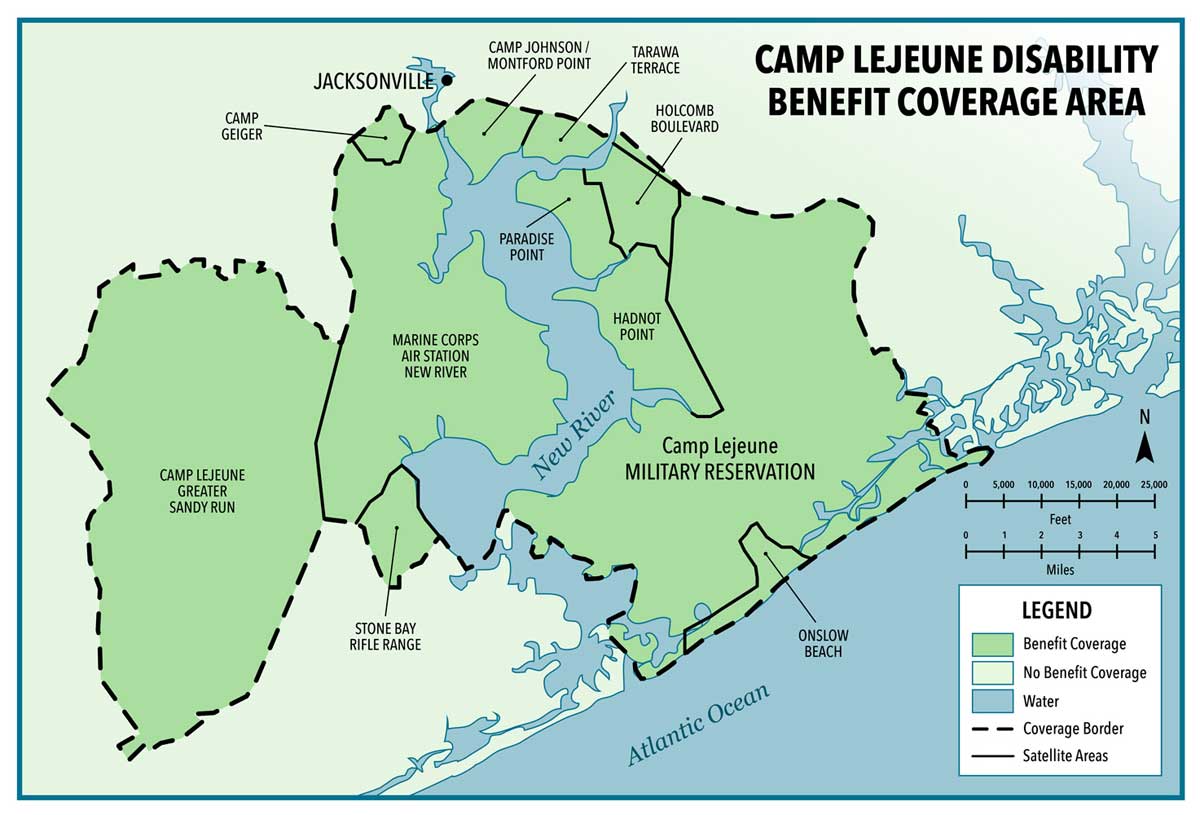
Marine Corps Base Camp Lejeune in Jacksonville, North Carolina is the site of one of the worst water contamination cases in United States history. During the years of 1957–1987 chemicals, degreasers, buried oli tanks, solvents, industrial waste water and toxic chemicals were knowingly dumped in the local storm drains. Residents in the surrounding areas and military living on base were exposed to multiple life threatening injuries. O’Connor and Partners PLLC is currently investigating Camp Lejeune induced injury cases. If you or anyone you know lived in or around Camp Lejeune for only 30 days during 1957-1987 and have developed illness through ingesting or bathing in toxic water, please contact us immediately, you have limited time to file a claim.
What injuries are associated with Camp Lejeune water contamination?
The U.S. Department of Veterans Affairs (“VA”) lists several diseases presumptively caused by Camp Lejeune water contamination. A “presumptive” service connection means that the VA presumes that the veteran’s military service caused the disease.
For veterans, reservists, and guardsmen, the VA lists the following diseases as being presumptively caused by the water contamination at Camp Lejeune:
Adult leukemia
Aplastic anemia and other myelodysplastic syndromes
Bladder cancer
Kidney cancer
Liver cancer
Multiple myeloma
Non-Hodgkin’s lymphoma
Parkinson’s disease
However, other diseases veterans and their family members suffer are also related to Camp Lejeune’s water contamination. The VA lists the following as potentially compensable diseases:
Breast cancer
Esophageal cancer
Female infertility
Hepatic steatosis
Leukemia
Lung cancer
Miscarriage
Myelodysplastic syndromes
Neurobehavioral effects
Renal toxicity
Scleroderma
If you are experiencing any of the above symptoms please contact us immediately for a free case consultation. Please use the form below to speak with one of our attorneys 24 hours a day at (845) 303-8777, you may be eligible to pursue compensation for your physical, emotional and financial losses.
Who is Covered? Camp Lejeune Legislation
According to the TheHill.com on June 23, 2022 in a 256-174 vote, with 222 Democrats and 34 Republicans in favor.The Camp Lejeune Justice Act would allow those exposed — even in-utero — to water contamination at the base for at least 30 days between Aug. 1, 1953, and Dec. 31, 1987, to file a claim in the U.S. District Court for the Eastern District of Northern Carolina. To do so, the bill would essentially override a North Carolina legal hurdle that has otherwise made such suits impossible.”Anybody who served in the United States Marine Corps, and went for combat training, probably went to Camp Lejeune in North Carolina,” Rep. Matt Cartwright (D-Pa.), the Camp Lejeune bill’s sponsor, told The Hill on Wednesday. “So this is not just a North Carolina issue; it’s a national issue.”
“Thirty-four years of people were exposed to toxins in the drinking water at Camp Lejeune,” Cartwright added.
Exposures to contaminants — such as trichloroethylene (TCE), tetrachloroethylene (PCE), vinyl chloride and others — at Camp Lejeune likely increased the risk of certain cancers, adverse birth outcomes and other health impacts from the 1950s through February 1985, according to the Centers for Disease Control’s Agency for Toxic Substances and Disease Registry (ATSDR).
How Can a Water Poisoning Lawsuit Attorney Help?
You may be eligible to file a Camp Lejeune lawsuit if you or your loved one was exposed to contaminated drinking water for at least 30 days between August 1, 1952 and December 31, 1987, suffered cancer or other health issues related to water contamination at Camp Lejeune.
If you lost a loved one meets the above criteria you may be able to pursue compensation for end-of-life expenses, such as funeral and burial costs, and other financial and emotional burdens that result from your injuries.
You Have a Limited Time to Pursue a Claim. Call Our Team Of Camp Lejeune Lawsuit Lawyers Today.
Contact O’Connor & Partners, PLLC today online or at (845) 303-8777 for a FREE CASE REVIEW. There is no cost or obligation to speak with an attorney and your case will be handled on a contingency basis, meaning you owe nothing unless a successful outcome is achieved in your case.